Beyond Minimum Age: A Better Standard for Youth eBike Safety

Beyond Minimum Age:
A Better Standard for Youth eBike Safety
The case for a Supervised-to-Certified Model that uses age to guide supervision while making demonstrated readiness the standard for independence.
There’s no question we have a youth eBike safety problem. Injuries are increasing. Families are buying vehicles they do not always fully understand. Kids are entering traffic without meaningful instruction. And increasingly, high-powered electric motorcycles are being ridden—and reported—as “eBikes” even when they do not legally qualify as eBikes at all.
We need to act. I’m just not convinced the answer is to pick an age and assume every child below it is incapable of riding safely.
I come at this from a few different angles: as a law-enforcement professional, as someone who works directly with young riders and parents, and as a father. My children are 9 and 12. I’m comfortable with both of them riding lawful eBikes when my wife or I are directly supervising them. I’m not yet comfortable sending either of them out alone.
The central idea
Age should help guide supervision.
Demonstrated competency should determine independence.
01 — The evidence
The data show a clear problem. Age alone does not tell us who is ready to ride.
California’s statewide injury trend
A 2026 UC San Diego statewide analysis looked at 4,035 reported eBike collisions and more than 58,000 traditional bicycle collisions in California between 2018 and 2024. Reported eBike collisions increased from just two in 2018 to 1,506 in 2024. Children 14 and younger made up a larger share of injured eBike riders than injured traditional bicyclists, and moderate-to-severe injuries were also more common among the eBike group.
Read the UC San Diego analysis.
Orange County pediatric trauma
The Orange County numbers are just as hard to ignore. Rady Children’s Health Orange County reported 201 pediatric eBike trauma patients in 2025, compared with 125 in 2024 and just one in 2021.
Reported increase from 2021 through 2025.
Reported in 2024 in the UC San Diego statewide analysis.
Share of reported e-motorcycle crashes involving riders ages 11–14 cited by the Orange County District Attorney.
Pediatric eBike trauma patients · Orange County
Reported eBike injury collisions · California
Those numbers make one thing clear: there is a real problem and we need to respond. But the numbers alone do not tell us what the right age cutoff should be. eBike ownership and use also grew substantially during this period, so rising injury counts need to be understood in that larger context.
The medical concerns around brain development, judgment and decision-making are real, and I’m not dismissing them. But kids do not all develop at the same pace, and a birthday does not suddenly make someone capable—or incapable—of making good decisions in traffic. Age matters. So do training, judgment, supervision and demonstrated competency.
02 — A cautionary case
New Jersey shows what can happen when a safety response becomes too restrictive.
What New Jersey changed
New Jersey took a much more restrictive approach. Under current state requirements, a rider must be at least 15 years old to operate an eBike and must have the required license. eBikes must also be registered.
The New Jersey Motor Vehicle Commission outlines the requirements here.
In practical terms, that means a responsible parent cannot take a 12-, 13- or 14-year-old on a supervised family eBike ride simply because the child has not reached the state’s minimum operating age.
Early warning from New Jersey
A safety law can have consequences beyond the safety issue it was meant to address.
In August 2026, Electrek reported that New Jersey bicycle dealers were describing eBike sales declines ranging from roughly 20% to 90%, along with layoffs and reductions in rental operations.
Those are dealer-reported figures, not a controlled statewide economic study. Still, they are an early signal worth watching.
Safety policy should reduce dangerous behavior without unnecessarily taking responsible family riding away with it.
03 — Schools
Schools have something more useful than a ban: leverage.
Newport-Mesa Unified School District is a good example. To its credit, the district is taking the issue seriously. Its 2026–27 approach includes education, testing, helmets and accountability.
What Newport-Mesa gets right
Education, testing, helmets and accountability.
Those are meaningful tools, and they show that schools can tie campus riding privileges to education and responsible behavior.
Where I disagree
Removing eBikes from campus does not remove the safety problem from the community.
The district prohibits TK–8 students from bringing eBikes onto school property. But keeping an eBike off campus does not keep that child from riding it after school, on weekends, through a neighborhood or to a friend’s house.
Newport-Mesa’s published protocols provide the details.
That is where I think schools have an opportunity to go beyond simply saying no.
Want the privilege of riding a lawful eBike to school? Earn it.
Complete meaningful rider education. Demonstrate actual riding competency. Learn the rules of the road. Show that the device is legal. Require parent participation. Then issue a permit—and take that privilege away if a rider repeatedly shows they cannot handle it responsibly.
Most young riders and parents I have encountered are not looking for ways to break the law. More often, they simply do not know what they do not know.
Those families are reachable. In my experience, they are also the norm. Policy should not be built only around the worst behavior we see.
04 — The proposal
A different approach: Supervised-to-Certified.
Age still matters. The difference is that I do not believe it should be the only measure of whether a young rider is ready. The age ranges in this model are intended as practical guardrails—setting different levels of supervision and training as kids get older—while still allowing demonstrated competency to matter.
No age cutoff is going to perfectly reflect when every child is ready. A 13-year-old does not suddenly become a safer rider on a birthday, just as every 12-year-old is not equally unprepared. The goal is to use age to help manage risk, while using training, judgment and demonstrated competency to determine when greater independence makes sense.
We already use a version of this approach with young drivers. Age helps determine the level of oversight, but education, testing, restrictions and demonstrated competency also play a role in how much independence a young driver receives. I think youth eBike policy can follow the same basic idea: more supervision when riders are younger, followed by greater independence as they demonstrate they are ready for it.
Proposed policy model
The Supervised-to-Certified Model
A youth eBike model that keeps supervised family riding available while requiring riders to demonstrate they are ready before riding independently.
At age 16, riders who become licensed move into California’s normal licensing system. If a rider is 16 or older but is not yet licensed, recognized competency certification should still be required before independent eBike riding.
Lawful Class 1 or Class 2 eBike riding only with direct parent or guardian supervision.
Independent riding only after completing recognized competency-based rider education that includes practical riding skills, rider knowledge, assessment and parent participation.
Three separate sustained moving violations within 12 months should trigger a meaningful restriction on independent riding privileges.
Certification should mean a rider can actually do it.
For riders 13 to 15, certification should not mean watching a video and clicking through a quiz. It should include hands-on riding skills + rider education, a knowledge assessment, device recognition, parent participation and a real demonstration that the rider can safely handle the eBike.
What V2RT looks like in practice
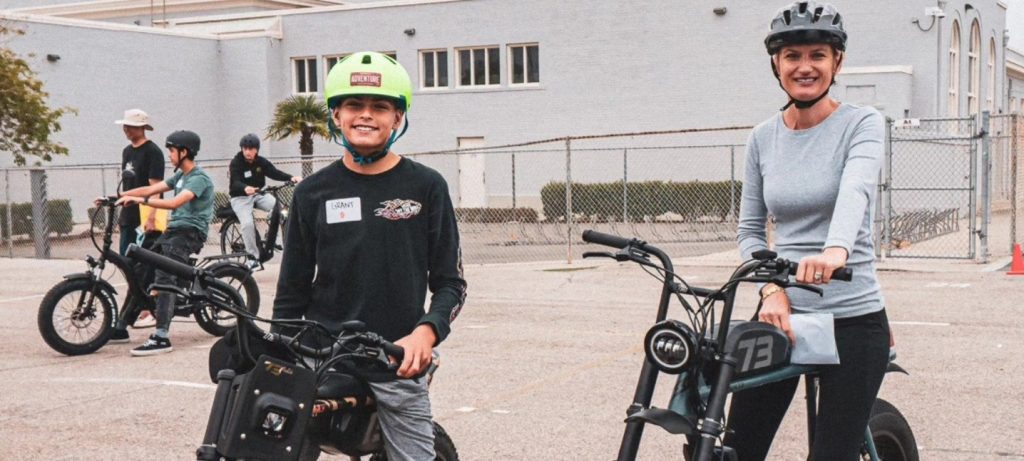
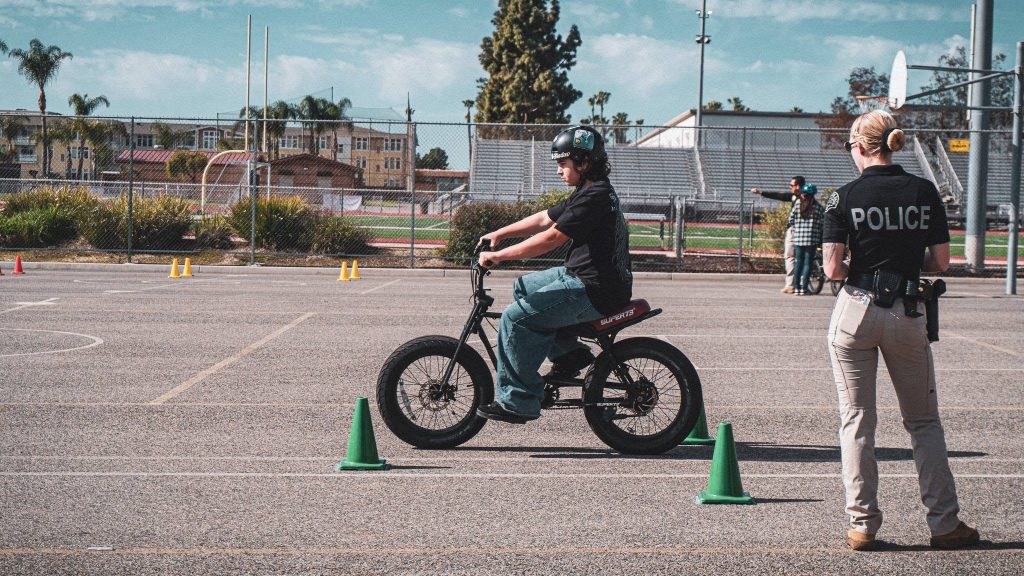
VoltVerified Rider Training (V2RT) is one example of how this can work in practice. A typical V2RT experience is approximately two hours and combines practical riding skills with rider education, assessment and parent involvement.
Removing the barrier to education
Approximately two hours. Free to riders and families. Come back anytime.
V2RT rider training is provided at no cost to participating riders and families.
Hands-on riding skills and rider education are combined into one practical training experience.
Riders can return as many times as they would like to reinforce skills, build confidence or simply get more practice.
Families should not have to pay for private instruction just to prove a young rider is ready. If education becomes part of the path to independent riding, communities should make that training accessible and give riders opportunities to come back, practice and keep improving.
The idea is bigger than any one program. States, counties, cities and school districts could adopt clear standards for recognized competency-based rider education and build programs that meet them.
Proposed Decision Framework
| Rider | Class 1 / 2 | Class 3 | High-Speed eMoto / Motor Vehicle |
|---|---|---|---|
| ≤ 12 | Direct parent / guardian supervision | Not permitted | Applicable motor-vehicle laws apply |
| 13–15 | Independent after recognized competency certification | Not permitted | Applicable motor-vehicle laws apply |
| 16+ | Licensed riders follow normal eBike rules. Riders who are 16 or older but not licensed should still complete recognized competency certification before independent riding. | Permitted subject to California requirements. Under this proposed model, an unlicensed rider should still complete recognized competency certification before independent riding. | Applicable licensing, registration and vehicle rules |
This is a policy model, not a claim that every detail has already been proven at statewide scale. It should be tested, measured and adjusted based on what actually happens in the real world. If communities adopt this approach, we should track collisions, violations, repeat violations and whether training is actually changing rider behavior. If the data show that parts of the model need to change, then we should change them.
05 — Accountability
Independent riding should be a privilege a rider can lose.
Education has to come with accountability. One mistake can still be a teachable moment, but repeated violations — or one especially dangerous act — should tell us when a rider is not ready for independent riding.
Certification should show that a young rider is ready to ride independently, not create a permanent entitlement to do so.
Three separate sustained moving violations within 12 months, or a single egregious act that shows a serious disregard for public safety, should be enough to suspend that privilege and require some form of corrective intervention before it is restored.
That could include participating in a street takeover, deliberately riding at vehicles or pedestrians, or other behavior that creates an immediate and substantial risk of injury.
After a suspension, I would support requiring a meaningful violation-free period, along with appropriate education or corrective intervention, before independent riding is restored. At 16, riders who obtain a driver’s license would move into California’s normal licensing framework. If they are 16 or older and still unlicensed, recognized competency certification should continue to be the standard for independent eBike riding.
Do not restrict every child because of what some riders might do. Focus the consequences on riders whose own behavior repeatedly shows they are not ready.
06 — Classification
Before we regulate “eBikes,” make sure the problem vehicles are actually eBikes.
This may be one of the most overlooked parts of the entire discussion. When a high-powered electric motorcycle, moped or other motor vehicle is described in a crash report, news story or community discussion simply as an “eBike,” it matters. If we classify the vehicle incorrectly, we can end up with bad data—and bad policy built on top of it.
California law already distinguishes these vehicles.
Vehicles that fall outside California’s lawful eBike limits may be entirely different types of motor vehicles. California’s Attorney General has specifically highlighted the importance of separating lawful eBikes from faster and more powerful electric two-wheeled vehicles.
Device recognition matters
Not everything called an “eBike” is an eBike.
Public discussion often lumps very different vehicles into one category. That can distort enforcement, crash reporting, injury data and ultimately policy.
A Class 1, Class 2 or Class 3 device operating within California’s lawful eBike definitions.
A motor-vehicle classification with different operating, licensing and equipment requirements.
Descriptive terminology for certain high-performance electric devices with pedals that fall outside lawful eBike operation.
A high-powered electric motor vehicle—not automatically an eBike simply because it has two wheels.
*“Pedal eMoto” is descriptive terminology. Legal classification ultimately depends on the vehicle’s specifications and applicable California law.
Before policymakers write new rules for “eBikes,” they need to know whether the vehicles creating the problem are actually eBikes.
A legislative approach aimed at the actual problem
Sen. Catherine Blakespear’s SB 1167 gets to the root of the classification issue.
This is the kind of legislation VoltVerified supports. Instead of treating every electric two-wheeler as the same thing, SB 1167 works to make the differences clearer at the point of sale—before a parent buys the device and before an officer ever encounters it on the street.
As currently amended, the bill strengthens the separation between lawful eBikes and vehicles such as mopeds, motor-driven cycles and off-highway electric motorcycles. It addresses how these devices can be advertised and labeled, strengthens consumer disclosures for vehicles that are actually motor vehicles, and would require crash and injury reports involving these categories to capture identifying label or marking information when available.
That matters because getting the classification right should start with the manufacturer and seller. Parents, schools, hospitals and police should not have to figure it out after something goes wrong.
Why that distinction changes the policy discussion
The Orange County District Attorney has reported that 61.7% of e-motorcycle crashes involved riders ages 11–14. Those incidents absolutely belong in the youth electric-device safety discussion. But they should not automatically be used as evidence against a lawful 20-mph Class 1 or Class 2 eBike.
The OCDA’s reporting illustrates why classification matters.
Getting the device right is not a minor technical detail. It affects enforcement, crash statistics and the policy decisions that follow.
07 — Enforcement
Enforcement is part of the answer—but officers need the right information first.
Officers cannot consistently enforce electric-device laws if they cannot first determine what type of vehicle they are dealing with. Device recognition has to come first.
California POST-certified instructor training
Recognition. Enforcement. Education. Diversion.
- Identify the device correctly before deciding which laws apply.
- Understand California eBike and electric-device laws and apply them appropriately.
- Build local rider-education programs that reach young riders and parents before unsafe behavior turns into a collision.
- Use diversion when appropriate—education, counseling or corrective training instead of simply paying a fine—so eligible young riders learn from the violation rather than only being punished for it.
VoltVerified’s California POST-certified 40-hour eBike Instructor Course prepares officers to work across all of those areas. Diversion is especially important because many youth violations start with a lack of education, not deliberate defiance.
The goal is not to excuse dangerous behavior. It is to correct it. A free, repeatable rider-training option gives agencies another tool: a young rider can get the education, come back for more practice and reinforce the skills that may prevent the next violation or collision.
Repeated or deliberate dangerous behavior still calls for meaningful enforcement. Education and enforcement can—and should—work together.
08 — Shared data
Law enforcement and health systems should be looking at the same picture.
Law enforcement sees the crashes, traffic violations, device types and rider behavior on the street. Trauma centers and health systems see the injuries, helmet use and practical rider safety, hospitalization data, age trends and medical outcomes.
Schools have direct access to riders and families. Parents control what is purchased and, especially for younger riders, when and how it is used. Public-health organizations can help connect those pieces, fund prevention and evaluate what is actually working.
A shared safety ecosystem
Five partners. One clearer picture.
- Parents — device choice, supervision and reinforcement at home.
- Schools — access to families, education, permits and accountability.
- Law enforcement — device recognition, crash investigation, enforcement, rider education and diversion.
- Trauma centers — injury severity, helmet use, age trends, hospitalization and medical outcomes.
- Public health and funders — prevention strategy, funding, evaluation and connection of community data.
What better data should tell us
Not just “Are youth injuries increasing?”—but why.
Communities should be able to connect what is happening on the street with what is showing up in the emergency department.
- What type of device was involved—and was it legally classified?
- How old was the rider, and had the rider received meaningful education?
- Was a helmet worn, and was excessive speed a factor?
- Were there prior violations or previous intervention?
- Did education, enforcement or another intervention reduce future injuries or violations?
That is the kind of picture trauma centers, law enforcement, schools and public-health partners should be building together.
09 — Objections
The questions I hear most often.
Why not simply make the minimum age 16?
Because turning 16 does not automatically make someone competent, just as being younger than 16 does not automatically make someone unsafe. Age should matter, especially when deciding how much supervision a young rider needs. But before a rider is given independence, I would rather see actual knowledge, judgment and riding competency than rely on age alone.
Is certification realistic?
Yes. Schools already tie privileges such as parking and athletics to certain requirements. A meaningful rider credential can work the same way.
Would certification create an equity problem?
It could if we require certification but make families pay for it or travel long distances to get it. Access has to be part of the policy. V2RT is free to participating riders and families, takes approximately two hours, and allows riders to return as many times as they would like. If competency certification becomes a condition of independent youth riding, communities should provide free or subsidized training through schools, cities, health systems, grants and community partnerships.
Does this let dangerous young riders keep riding?
No. It keeps responsible riding available while creating stronger consequences for riders whose own behavior repeatedly shows they are not ready to ride independently.
A practical framework communities can adapt
Five Principles for Smarter Youth eBike Policy
- Age should help guide supervision; demonstrated competency should determine independence.
- Get the device classification right before using the data to shape enforcement or policy.
- Meaningful education should come before independent riding—not after the first collision or citation.
- Schools should use access as leverage for education and accountability instead of relying only on prohibition.
- Enforcement should focus the strongest consequences on illegal devices and repeated dangerous behavior while preserving responsible supervised riding.
The medical data make it clear that doing nothing is not an option. But the choice is not simply between doing nothing and banning younger riders from eBikes.
There is a better middle ground, and I think it starts with matching independence to demonstrated readiness.
Supervise younger riders. Educate them before they ride independently. Make that education accessible. Let them come back and keep learning. Require them to demonstrate competency. Hold repeated dangerous behavior accountable. Help parents understand what they are buying. Train law enforcement to recognize the vehicles they encounter and apply the right laws. And connect health data with what is actually happening on our streets.
And before we write the next law in response to an “eBike” crash, make sure the vehicle involved was actually an eBike.
That is how we improve safety without unnecessarily taking responsible riding away from kids and families.

Mike Thomas is the founder of VoltVerified and a California law-enforcement professional whose work focuses on eBike safety, rider education, law-enforcement training and community implementation. The views expressed in this analysis are his own.
Primary Sources & Further Reading
The record behind this analysis.
UC San Diego — Statewide California eBike Injury Analysis
California collision and injury analysis, 2018–2024.
Rady Children’s Health Orange County / CHOC — Pediatric eBike Trauma
Orange County pediatric trauma trends and speed-related injury findings.
New Jersey Motor Vehicle Commission — eBike Requirements
Official state licensing, age and registration requirements.
Newport-Mesa Unified School District — Bike & eBike Protocols
District education, testing and campus-access requirements.
California Department of Justice — eBike Legal Requirements
California guidance regarding lawful eBikes and other electric two-wheeled vehicles.
Orange County District Attorney — eBike / e-Motorcycle Safety & Enforcement
Orange County youth e-motorcycle crash and enforcement information.
Electrek — Early Dealer Reports Following New Jersey’s eBike Law
Secondary reporting on dealer-reported market effects; included as an early signal rather than a controlled economic study.